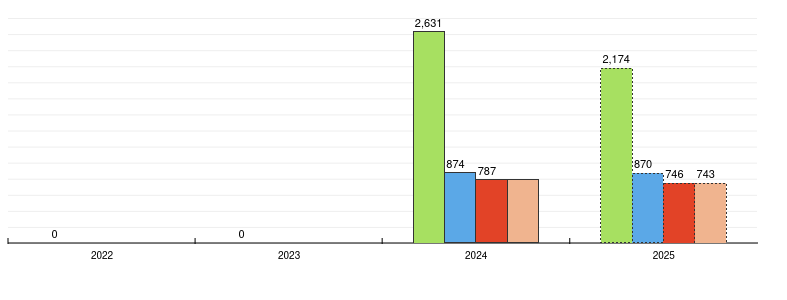
.:: Indexing ::.

Scopus:


Authors who intend to submit manuscripts to Vocational: Journal of Educational Technology are required to carefully follow these Author Guidelines. Compliance ensures academic quality, transparency, ethical integrity, and international publication standards.
Manuscripts submitted to Vocational: Journal of Educational Technology must be:
Submissions must align with the journal’s aims and scope, including but not limited to:
1. Educational technology and digital learning innovations
2. Vocational education and training (VET)
3. Artificial intelligence in education (AIED)
4. Mobile learning and e-learning systems
5. Learning management systems (LMS) and instructional design
6. Gamification and game-based learning
7. Computational thinking and STEM/STEAM education
8. Technology integration in teaching and learning
9. Digital literacy and 21st-century skills
10. Online and blended learning environments
11. Assessment and evaluation in technology-enhanced learning
12. Human-computer interaction in education
13. Data analytics and learning analytics
14. Emerging technologies in education (e.g., AR/VR, IoT, blockchain)
All manuscripts must be written in clear academic English.
Submissions are accepted only through the online journal system.
A complete manuscript must follow this structure:
Authors must specify contributions using the CRediT taxonomy, such as:
Authors must state where data can be accessed:
Authors must declare any conflicts of interest or state:
“The authors declare no competing interests.”
Authors must disclose the use of AI tools in manuscript preparation. AI tools may only be used for language improvement, not for generating scientific content.
Article Template: Available on the journal website
Before submission, authors must ensure:
All submissions undergo:
Average review time: 4–8 weeks
Detailed information is available at: https://jurnal.smpharapanananda.sch.id/index.php/vocational/peerrev
Vocational: Journal of Educational Technology charges an Article Processing Charge (APC) of IDR 300,000 per accepted article, effective November 1, 2026.
There are no manuscript submission fees, peer-review fees, or additional mandatory author charges.
The APC applies to manuscripts formally accepted for publication on or after November 1, 2026, regardless of their initial submission date. Manuscripts accepted before this date are not subject to the APC.
Payment is requested only after formal acceptance and receipt of official payment instructions from the editorial office. APC payments do not influence peer review, editorial decisions, or manuscript acceptance.
Detailed information on publication charges and applicable policies is available on the journal's official APC page: https://jurnal.smpharapanananda.sch.id/index.php/vocational/fees
Articles are published under the Creative Commons Attribution 4.0 International License (CC BY 4.0).
Authors retain copyright.
All submitted manuscripts are screened for potential plagiarism using appropriate similarity detection software.
The journal applies a maximum similarity index of 25% as an initial editorial screening criterion. Similarity reports are assessed contextually, considering properly cited quotations, references, methodological terminology, and other legitimate textual overlaps.
A similarity score below the threshold does not automatically establish originality or guarantee manuscript acceptance. Suspected plagiarism, regardless of the similarity percentage, will be assessed in accordance with the journal's publication ethics policy.
The journal follows COPE (Committee on Publication Ethics) guidelines.
Full policy: https://jurnal.smpharapanananda.sch.id/index.php/vocational/pubethic
Editorial Office
Email: vocational@smpharapanananda.sch.id
Website: https://jurnal.smpharapanananda.sch.id/index.php/vocational
Author Guidelines page: https://jurnal.smpharapanananda.sch.id/index.php/vocational/authorguidelines





Editorial Office:
Vocational: Journal of Educational Technology, Yayasan Pendidikan dan Pengembangan Harapan Ananda.
Jln. Arteri Supadio, Komplek Pondok Indah Lestari, Sungai Raya, Kubu Raya, Kalimantan Barat, Indonesia, 782393.
Telp/Fax: +62 82386200610
E-mail: jvocational@smpharapanananda.sch.id

Vocational: Journal of Educational Technology is licensed under a Creative Commons Attribution 4.0 International License