Analysis of Students' Errors in Solving Analytical Geometry Parabolic Problems
DOI:
https://doi.org/10.58740/logarithma.v1i1.789Keywords:
Analytical Geometry, Conic Sections, Error Analysis, Fong’s Scheme, ParabolicAbstract
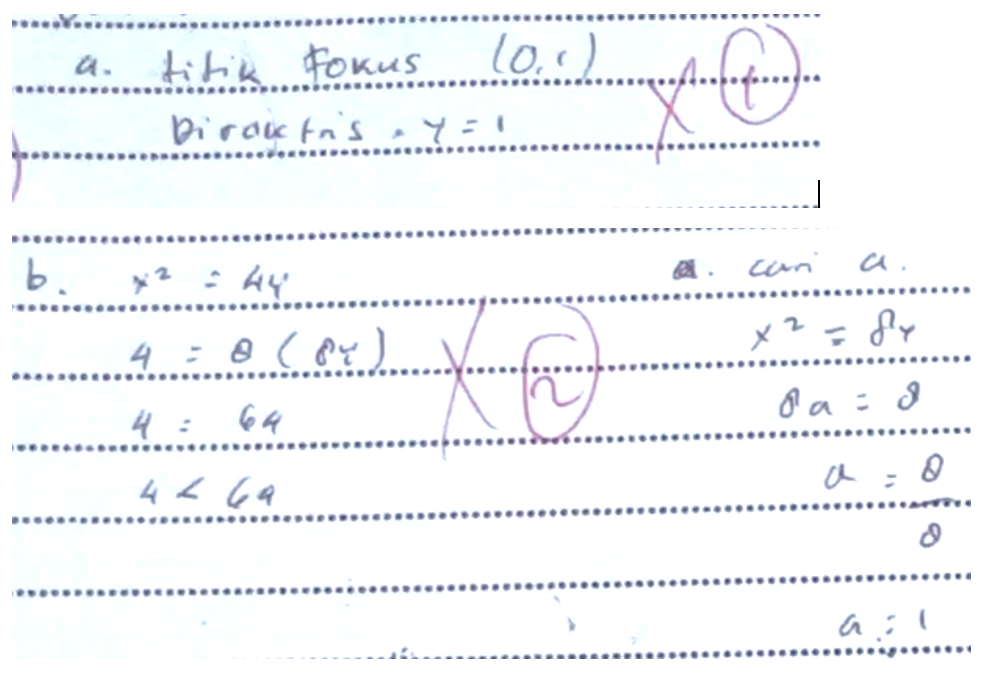
This study aims to analyze students’ errors in solving parabola problems in conic sections based on Fong’s scheme. The research employed a qualitative descriptive method involving students enrolled in the Analytical Geometry course. Data were collected through written tests and interviews. The instrument consisted of descriptive problems related to parabola equations, focus, directrix, axis of symmetry, direction of opening, and latus rectum length. Data analysis referred to Fong’s scheme, which classifies errors into five first-level categories: (E1) no solution, (E2) inappropriate procedures, (E3) incomplete schema without solution, (E4) incomplete schema with errors, and (E5) complete schema with errors. The findings revealed that the most dominant errors were category (E4) at 33.33% and category (E2) at 30%. Category (E3) errors accounted for 16.67%, while categories (E1) and (E5) each contributed 10%. Based on the second-level analysis, students made language, operational, mathematical theme, and psychological errors. These errors were caused by limited conceptual understanding, inaccurate formula application, and lack of accuracy in algebraic operations. Therefore, analytical geometry instruction should emphasize conceptual understanding and visualization to improve students’ systematic and accurate problem-solving abilities.
Downloads
Published
How to Cite
Issue
Section
License
Copyright (c) 2026 Reny Wahyuni, Efuansyah

This work is licensed under a Creative Commons Attribution 4.0 International License.